By Dave Bedford
This article is brought to you by David Bedford, a regular attendee to our support groups and events. David is also an ADHD coach and originator of the term HAuDHD, a term used to describe someone who identifies as AudHD who is also hard of hearing. In this article David gives some insight into navigating a world through the lens of someone who has a combination of presentations including Hard of Hearing, Autism and ADHD. Dave the founder of AuDHD unzipped.
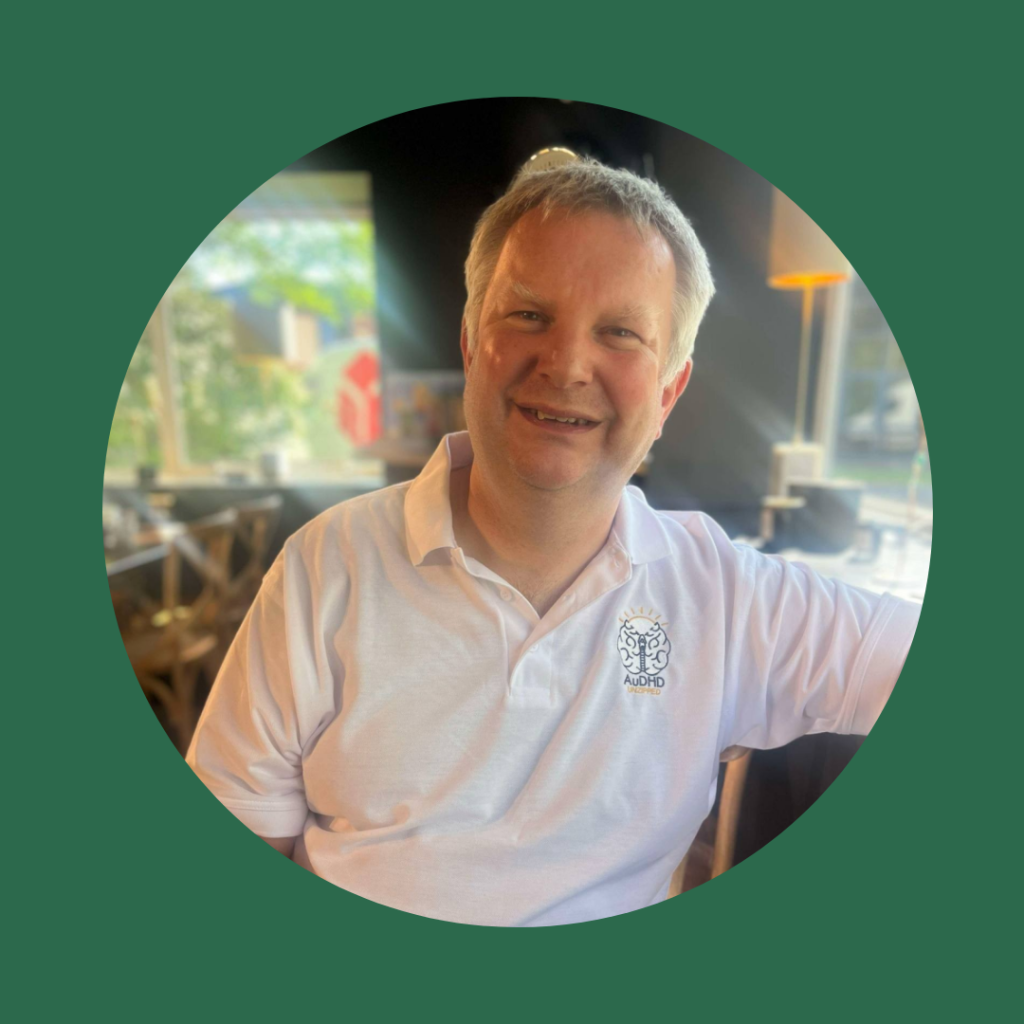
Hi. I’m Dave Bedford, and I’m HAuDHD™.
“What’s HAuDHD™?”, you may well ask. Well, here is the answer.
It’s the amalgamation of three separate parts. I like to think of it as how the separate vehicles docked together inside the main ship called the Phoenix, in Battle Of The Planets. Or perhaps more aptly, how the three vehicles combined to become the giant robot in the excellent Starfleet.
But, I’m going off on an 80s nostalgia tangent here, and, if I’m not careful, I’ll be talking about the up and coming Masters Of The Universe movie that is released later this year.
Which is not what this blog is about.
So, just what are the separate components of HAuDHD™?
They are:
- Hard of Hearing
- Autistic
- ADHD
And I list them in that order because that is how I became aware of them in my life.
I was born Hard of Hearing. I mean, I was born HAuDHD™ actually, but no-one was aware of the other two components at that time. The Hearing issue was the one thing that was impossible to ignore from an early age.
I underwent regular hearing tests from as long as I can remember.
Most of my childhood was filled with memories of sitting in a room with headphones on, a wooden boat full of figures in front of me, and a teddy bear beside it.
“Whenever you hear a beep David, take a figure out of the boat and place it on the teddy bear’s head.”
When I was a bit older, I was given a clicker connected via a long cable to the devices the audiologists were using to record my responses. I no longer had to take figures out of the boat to put on the teddy bear’s head.
The hearing tests continued, and at the age of fifteen, my parents asked the audiologist whether they had a plan.
My audiogram – the graph of the frequencies that I can hear, or more accurately that I cannot hear – indicated that I had a severe to profound high frequency hearing loss in both ears. I was unable to hear high frequencies naturally. The only option available at the time was to be issued with analogue hearing aids.
Such hearing aids would amplify all the frequencies by the same level. This would result in the lower frequencies that I could already hear being amplified to such a level that they would drown out the high frequencies that I was wanting to be able to hear. The high frequencies in question needed to be amplified by a magnitude of 100db for me to stand a chance of hearing them, the volume of a motorbike engine! That would be a problem. Because the amplified low frequencies would then be ridiculously loud!
And so, it was decided that my audiology appointments would come to an end. I’d been taught to lip read to aid my communication, and was sent away with a hopeful parting statement that:
“Perhaps, in 10 or 15 years, we’ll have made enough advances in digital technology, that there will be something to help you by then.”
Now let’s get something straight.
I HATED being Hard of Hearing.
Because you can’t notice that someone is Hard of Hearing based on your 3 second judgement upon observing a subject. So such observations of me often delivered the perception that I was, at best, “different”. At worst, just plain “stupid”.
Growing up in the North of England, being different was a target for ridicule. Being stupid, a prime candidate for physical bullying.
I didn’t want to experience any of these. I needed a way to become invisible.
And so, I taught myself how to read body language and people’s expressions. Anything to give me an advantage. Some indication of people’s intentions. Perhaps the context of the conversation. All in the absence of hearing what was actually being spoken to me.
I learnt how to blag it. How to nod when people were expecting an affirmative response. When to shake my head when they might be expecting affirmation of their negative language. Echoing their “hmmms”, “Mmms”, “Ohhhs”, “Ooooohs”, and “Ahhhs”, whilst mirroring their body language.
All the while, not having a bloody clue what was being said to me.
I didn’t know it at the time, but I was masking.
Woah there Dave. Back up a bit. What is masking?
Well, I first encountered people doing it near a school playground way before we had our own kids. I had parked up in a car park adjacent to the school around the time of school pick up. Two Mums walked towards each other. They looked at each other purposely, wearing such ridiculously over the top smiles that they displayed in a sickening manner to each other. Once they passed each other, the smiles dropped. Their faces changed to ones of frowns and scorn. It looked like they called each other a “funky beach”. That’s what it looked like, or something similar in lip movement, I can’t be entirely sure…
But what they were doing was a form of masking.
Both Mums were camouflaging their natural feelings to each other. By displaying the over-the-top smiles, they were hoping to meet the expected school Mum playground etiquette. However, once out of eye contact of each other, they believed they were safe to return to displaying their natural feelings towards each other, that being of utter disdain.
Now, this is not why I was masking, not yet, anyway. Pretending to be someone else in order to be accepted within the school playground hierarchy, but at an adult age, was something I had yet to enter into. But the principle was the same. I was wishing to hide my natural traits that would be noticed as different to the accepted perception of normal.
I would have stuck out like a sore thumb out because I was Hard of Hearing:
- Not being able to hear
- So not being able to understand
- So not being able to keep up with the conversation
- Hearing things incorrectly and responding with something which has no connection to the topic of conversation
I was masking to look “normal” and not come across as “stupid”.
But why did my hearing loss make speech so difficult for me?
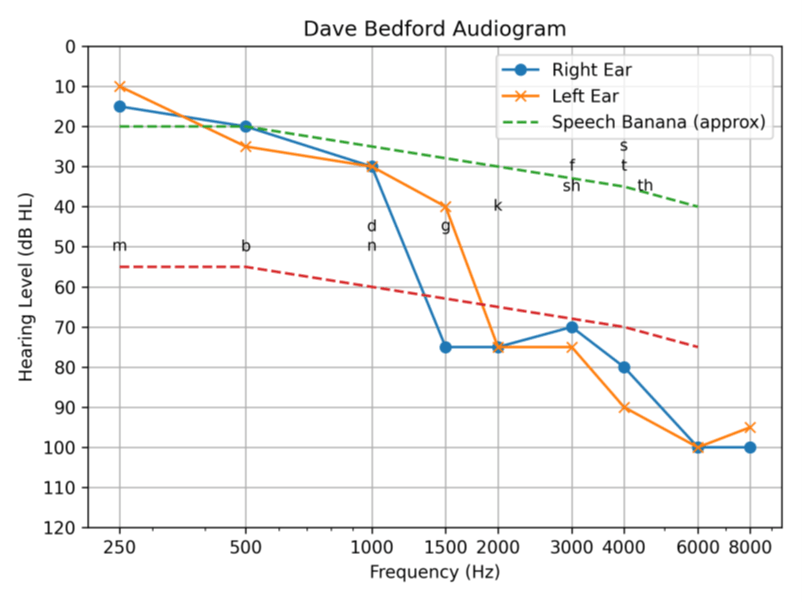
Someone considered to be without a hearing loss would be represented on the above graph as a horizontal straight line around the 0 – 20 db Hearing Level going from left to right from 250Hz – 8000Hz.
i.e. a horizontal line that would go straight across the top of the graph.
Mine however, descends and then starts to rapidly deteriorate once we start hitting the higher frequencies, meaning they need to be amplified by a level of around 60db+. This drop begins in the middle of the “speech banana”: a range where consonant sounds required to understand speech reside.
My hearing loss slices this “speech banana” in two. Half of the consonant sounds within it I am simply unable to hear naturally. As we progress further into the higher frequencies, these consonant sounds lie within so called “dead zones”. Areas where, for me, no matter how much the sounds would be amplified, I wouldn’t be able to hear them.
Leaving me to play a game of wordle all the time.
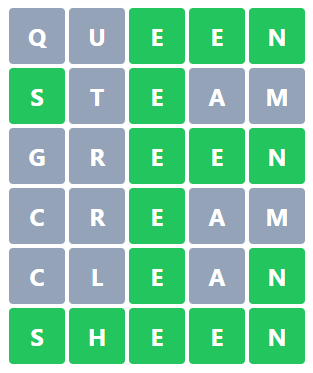
I’d quickly identify the vowel letters, but I would be desperately guessing which consonant sounds might fit, but more importantly might make sense. Then I’d rinse and repeat in order to try to formulate a sentence.
Then I’d hope and pray that my guess was correct and on topic.
Which is:
- Difficult
- Exhausting
- Embarrassing if you come up with a sentence that sounds like it belongs in “In The Night Garden”
“Ikka Nikka Rikka Sticker Pitter Patter Moo!”
Believe me, it’s not the first time I’ve arrived at such a nonsense sentence, and it won’t be the last!
When you come to not being able to trust your ears, you resort to doing anything to try to look like you’re following the conversation. But most of the time I would have no clue about what was going on.
And, through it, came my first experience of labels.
I went to a D/deaf and Hard of Hearing club. At the time, I referred to myself as being deaf. I always had done.
The meeting was a wonderful blend of people who were Deaf, deaf, or Hard of Hearing. You may think that there is no difference between the three terms. And I was in that bucket of thought as well, until I attended this meeting.
There was a lovely, friendly, very skilled interpreter standing up at the front, signing the spoken words. I remember finding both her, but most importantly British Sign Language, absolutely fascinating.
There was a slight delay as the words were heard, interpreted, and then communicated via a combination of her hand movements and facial expressions.
She was this very valuable interface between those whose primary language was spoken word and those whose primary language was sign language.
A woman was talking. She kept referring to herself as being deaf.
After a short period, other people in the room started signing simultaneously. And with very strong, determined, and exaggerated hand movements. There were looks of seriousness, and what seemed in some cases, anger on people’s faces.
And the interpreter then had to portray this frustration via her facial expressions. And also echo the severity of the hand gestures. And respond.
So she transformed from being extremely smiley, to also wearing this very passionate, focused look on her face as she communicated.
When the interpreter was able to relay spoken word once again, the reason for the response was able to be explained.
There was a very distinct difference between Deaf, deaf, and Hard of Hearing.
- Deaf is very much a cultural distinction. It is an identity. A belonging to a community with it’s own culture. Sign language is used as the primary language. Often born deaf or into deaf families. Very much viewing themselves as a cultural minority rather than having a disability.
- deaf is more focused on the medical aspect. Including those who lost their hearing later in life. Often using spoken language (oral), hearing aids, or cochlear implants. Sign language may well be used, but not as the primary language. They may not be actively involved in Deaf culture.
- Hard of Hearing has the level of hearing loss as the distinction from the other two. The key difference being that “something” can be heard. The hearing loss may be anything from mild, to moderate, to severe. But sign language is not the primary language of choice, and, in lots of cases, may not be engaged in at all. Typically, a combination of residual hearing, spoken language and assistive devices deliver the primary form of communication.
And so, when someone who was clearly in the “Hard of Hearing” category was referring to themselves as D/deaf, yet did not sign, and only had a mild hearing loss, this naturally caused a lot of offence to people in the room who quite rightly resonated with the term and regarded it as their cultural identity.
It didn’t help that the woman who was speaking would not change her opinion. As far as she was concerned, she was deaf and always had been and always would be.
I, on the other hand, vowed that I would always use the correct terms from now on.
I was Hard of Hearing. I was not deaf, and I certainly couldn’t claim to be involved in Deaf culture.
Yes, I struggled to hear. And as a result, I found communication difficult. But no, I was neither deaf nor Deaf. I could hear “something”, and I didn’t know a single sign from British Sign Language.
As I’ve established, I could hear “something”…
…but not “everything”. However, I was bloody good at pretending that I had no problems hearing it all.
I mean, to those who do not have any sight issues, it helped me that being Hard of Hearing isn’t a visible disability.
I’ve got these two flaps of cartilage slapped on either side of my head for starters, so it must appear as though I should be able to hear properly, right? Which would place an expectation from the outset.
Let me tell you another story.
I remember going to a party with my now wife. We weren’t even engaged at the time. My wife to be knew everyone there. I had only met a few people.
As soon as we arrived, my wife got whisked away from me, and she mouthed “sorry” as she was led into the house. I was left on my own, ready to press play on the act I’d perfected. Operation: Pretend To Be Fully Hearing. Okay, initiate said program.
I ended up sitting next to a woman from Ireland. She had a very strong accent. This meant that even the consonant sounds that I was familiar with were being pronounced in a different way. Some resulted in multiple syllables when I was used to them containing only one.
And the consonant sounds? I really struggled identifying them.
The wordle game was throwing up nothing of any use.
Little bits of “Oooh, and “Ahhh” sounds were all I was getting. It sounded like she might be entering the UK’s entry for the Eurovision Song Contest. But I didn’t think that it was Gina G that I was talking to. I was pretty sure that someone from Ireland wouldn’t represent the UK. But, then again, Gina G is Australian…
Anyway, back on target…
I sat there, mirroring her body language. Frowning when necessary. Giving looks of concern when it seemed appropriate. Assuring her that she was correct. Shaking my head in shared disagreement of whatever it was that she was saying to me that she wasn’t particularly happy about.
The whole shenanigans came to an end. My wife returned. We were climbing into our car seats, and closing our doors against the winding down of party. I turned the key in the ignition to start the engine in order to commence the drive home.
That’s another thing! I’d usually have navigated these kind of scenarios by resorting to alcohol. More on that later, but, because I was driving, I had to traverse this experience totally sober!
“It’s terrible about Zoe, isn’t it?”, my wife exclaimed.
“Zoe, who’s Zoe?”, I asked.
“Zoe, the Irish girl you were speaking to all night!”
“Oh, that was her name, was it? Sorry, I didn’t catch it!”
“It’s shocking what she’s been through these last few months, isn’t it?”
“Why, what’s she been through?”
“Hang on, you were talking to her all night, and at the end of the night she said to me that you had been so lovely, had given her great advice, and she knew now how to move forward with her life! What did you tell her?”
I explained how I hadn’t really said anything apart from, “Yes”, “No”, “Right”, “OK”, M-Hmm”, “Ah”, “Oh”, “Uh-uh”, and other such non-lexical conversational sounds. So, I hadn’t actually told her anything or offered any advice. All I had done was mirror her own behaviour and assertions, whether they positive or negative, back towards her.
My wife then went on to relay Zoe’s story. Supposedly the second time I had been told this, but the first time that I had actually “heard” it. When my wife had finished, I too, wondered just what advice it must have been that I’d given her based on responses consisting solely of filler words uttered with the correct tone and accompanied by the appropriate facial expression.
This continued ability to mask has been a blessing, as well as a curse.
At the age of 30, I received digital hearing aids. Fifteen years after I was told that in ten or fifteen years, advances in technology might help me. Quite the prophecy. Suddenly, I was able to hear more frequencies than before, providing me with better opportunities to understand conversations.
Up until this time, I had used alcohol as a way to blend in.
Alcohol was amazing. It lowered everyone else’s inhibitions and also their recollection of the social gatherings. They didn’t notice that I was struggling to follow things. Much like the party with the Irish girl, they heard what they wanted to hear and interpreted what they wanted to interpret. To them, I’d followed along beautifully and had been able to contribute perfectly. In reality, the only conversations I’d been confident in having were the ones where I’d ordered another bottle of big Budweiser, or the kebab on the way home. Any successes I had were forgotten by myself, because I was also consuming alcohol myself, meaning I was unable to repeat anything which may have worked previously.
I had always placed my social struggles solely down to being Hard of Hearing.
Nearly a decade after receiving my digital hearing aids, my youngest received an ASD diagnosis, as it said on the documentation. Autism Spectrum Disorder. The path to this diagnosis had been via their own hearing tests, for I dearly wished for neither of my children to have the same struggles as I had.
“Please God, don’t let them have the same hearing problems as I did. Anything, anything but that.”
Careful what you wish for, eh?
And so, I sat there, after being told of his diagnosis, and was handed a list of things that my son might struggle with.
As I scanned down the list:
- Social communication
- Misunderstanding social rules
- Literal interpretation
- Sensory processing
- Becoming overwhelmed by too many noises
- Resistance to change in routine
I scoffed, and stated, out loud how, “Everyone would struggle with these!”
Apparently, no they wouldn’t, and so, at the age of forty, I received my own Autistic diagnosis.
And it answered a lot of things, and I understood how it could have hidden beneath the umbrella of me being Hard of Hearing.
Because of being Hard of Hearing, I already knew how to mask to look “normal”. I was academically bright, so I had managed to pass through the school system undetected. As far as the school was concerned, I was a very hopeful prospect, with a high potential of contributing to the number of high grades they sought if they invested in me. And I delivered on the promises and forecasted grades. For all intents and purposes, to them, I was “OK”.
All the struggles I experienced went unnoticed, because I hid them so well.
And there was alcohol as I’d mentioned.I didn’t realise it until my diagnosis of ADHD at the age of 50 (I do things in decades) that I had used it to self medicate.
There is a Van Halen lyric that I am fond of: “To kill the pain, or numb my Brain”
To physically drown out pain that painkillers could not touch. But to switch my Brain off. I always considered Brain to be a flywheel. Sometimes he would take a while to get spinning (Autistic inertia), but, once he really got going, I was unable to stop him (Hyperfocus).
And the exhaustion from masking had often led to burnout.
So now, I’m revisiting the separate parts of myself, in a bid to understand myself better.
I’m a big believer in the word “synergy”. That the combined result produces a total, greater effect than the sum of the individual parts.
Yes, I’m Hard of Hearing, Autistic, and ADHD.
I’m HAuDHD™.
Which I consider to be a pyramid, with Hard of Hearing on the bottom, then being Autistic, with ADHD on the top, based on the order of my exposure to them.
For years, the separate parts felt like problems to hide, apologise for, to make invisible.
But they’re a system. A complicated one, but ultimately the components make me who I am.
The better I can understand these individual parts, the greater chance I have of successfully connecting them. I can then actually work with my Brain instead of fighting it, or trying to escape from it.
I was never broken, I was just a T.V. programme without subtitles. A LEGO set without the instruction manual.
And so I’m on a mission to subtitle and assemble it myself.
In a bid to be confident in combining them together to form that giant Starfleet robot with which I can go forward and smash it.
Hopefully accompanied by the Brian May / Eddie Van Halen version of the theme tune that they recorded for it.
That version of the theme tune comes highly recommended!


 Reading ADHD Group
Leave a comment